
Why a Managed WordPress Care Plan Matters for Your Business
Your website is not a side asset. For many small businesses, nonprofits, and organizations, it plays a direct role in credibility, lead generation, customer trust, and day-to-day operations.
When a website is outdated, unstable, slow, or partially broken, the cost is not just technical. It can mean missed leads, frustrated visitors, damaged trust, wasted advertising spend, and unnecessary stress for your team.
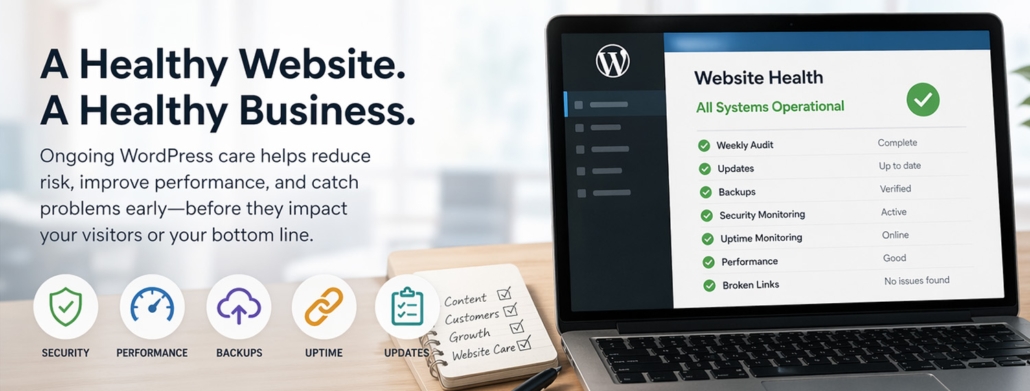
That is why WordPress care should not be handled as an afterthought or only addressed when something goes wrong. A proactive WordPress care plan helps reduce risk, improve stability, and catch issues early, before they turn into bigger and more expensive problems.
Just as important, there is a major difference between a care plan managed by a real company with human oversight and one that relies only on automated software. Tools are useful. Automation has its place. But software alone cannot replace judgment, accountability, or real support.
A well-managed WordPress care plan is not just technical maintenance. It is a practical form of business risk management and website continuity.
Your website needs ongoing care to stay reliable
WordPress is a flexible and widely used platform, but it is not static. The WordPress core software evolves. Plugins and themes release updates. Hosting environments change. Security vulnerabilities are discovered. Third-party integrations shift over time.
Even a well-built site needs ongoing attention to remain stable and dependable.
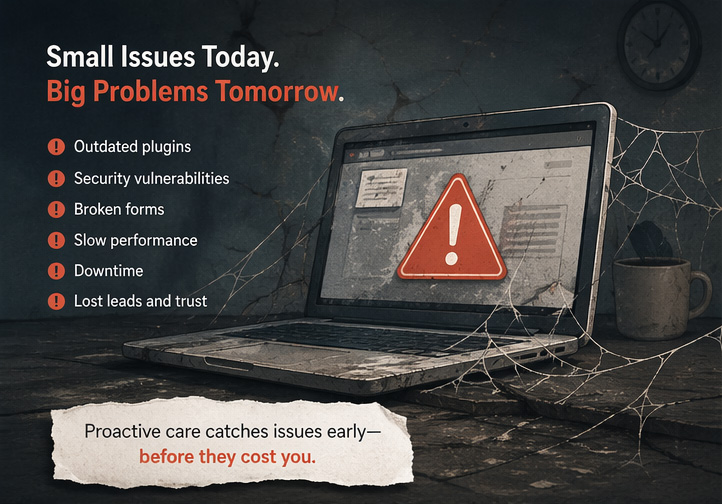
Without regular care, problems can build quietly in the background. Often, they are not visible from the home page. A site may look fine at first glance while important functions are already failing behind the scenes.
Common examples include:
- A plugin vulnerability that leaves the site exposed
- A theme or plugin update that causes a compatibility issue
- A contact form that stops sending leads
- A website that goes down without anyone noticing right away
- Slow performance that drives visitors away
- An expired SSL certificate that creates browser warnings
- Broken links or missing pages that hurt trust and usability
- Hidden site errors that sit unnoticed until a customer reports them
Most business owners do not have the time or desire to watch for these issues every week. That is exactly why a structured care plan exists.
“Set it and forget it” is risky for WordPress websites
A WordPress website is not something you launch once and safely ignore for years.
That approach may seem fine for a while, especially if no obvious problems appear. But websites change over time, even when you are not actively working on them. Software updates are released. Security issues emerge. Hosting conditions change. Browsers and devices evolve. Services connected to your site can also change in ways that affect functionality.
The risk is not only that something breaks. The risk is that something breaks quietly.
A form may stop working and no one knows until leads have already been lost. A plugin may become vulnerable and sit exposed for weeks. An SSL certificate may expire and create a warning that scares visitors away. A performance issue may gradually get worse and reduce conversions over time.
That is why “set it and forget it” is not a responsible strategy for a business website. The site may still exist online, but that does not mean it is healthy, secure, or working the way it should.
The difference between proactive care and reactive maintenance
Many website owners are stuck in a reactive pattern. Nothing gets checked until something breaks. Then the issue becomes urgent, stressful, and often more expensive to fix.
That is not a care plan. That’s emergency response.
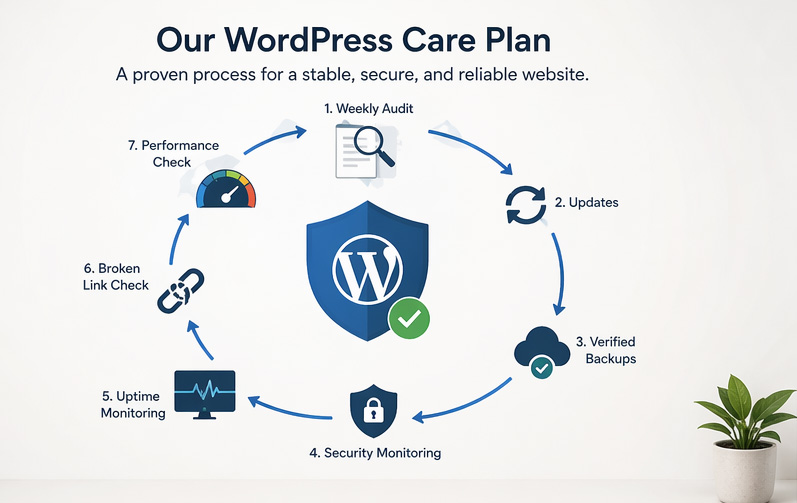
A proactive, structured WordPress care plan is different. It is built around regular weekly attention designed to reduce risk and catch problems early.
Instead of waiting for a customer, donor, staff member, or business owner to discover a problem, the website is being reviewed on an ongoing basis by people who know what to watch for.
A strong care plan should include:
- Weekly audits
- Weekly plugin, theme, and WordPress core updates
- Regular verified backups
- Security monitoring
- Uptime monitoring
- Broken link checks
- Performance checks
This kind of structure matters because it helps prevent small issues from turning into larger business problems. It is often the difference between a quick correction and a costly disruption.
Why weekly audits matter
Weekly audits are one of the most important parts of a serious WordPress care plan.
They matter because many website problems begin small. A plugin may become outdated. A form may stop working after an update. A page may start loading slowly. A security issue may appear in software the site depends on. A monitoring alert may point to a real issue that needs follow-up.
If those problems are caught early, they are usually easier, faster, and less expensive to address.
A weekly audit creates a regular checkpoint to review the health of the site and look for issues before they become more damaging. For many small business and nonprofit websites, weekly review is a practical and responsible cadence. It is frequent enough to catch important issues early without making the process unnecessarily heavy.
A weekly audit can help detect:
- New plugin or theme vulnerabilities
- Failed or incomplete updates
- Broken forms or malfunctioning features
- Pages returning errors
- SSL issues
- Uptime incidents
- Broken links
- Slow performance or unusual site behavior
This is not about creating alarm. It is about reducing avoidable risk through routine attention.
Why updates matter
Updates are not just housekeeping. They are a key part of keeping a WordPress site secure, compatible, and reliable.
WordPress core, plugins, and themes all need updates over time for several reasons.
First, security. Vulnerabilities are regularly discovered in plugins and themes. Leaving outdated software in place for too long can unnecessarily increase exposure.
Second, compatibility. WordPress sites depend on multiple software components working together. Updates help maintain compatibility between core, plugins, themes, PHP versions, hosting environments, and browsers.
Third, reliability. Many updates fix bugs, improve performance, or correct functionality issues that affect how the site behaves.
At the same time, updates are not something to push blindly and forget. They need to be handled within a managed process. Sometimes an update creates a conflict, changes layout behavior, or affects a critical feature. That is one reason human oversight matters so much. It is not enough to know an update ran. Someone needs to make sure the website still works properly afterward.
Why backups matter, and why they should be verified
Backups are essential because they provide a recovery path when something goes wrong.
If a site is hacked, a change fails, an update breaks functionality, or an important file is lost, a usable backup can make the difference between a manageable recovery and a major business disruption.
But there is an important distinction here. Backups are only valuable if they are real, recent, and restorable.
Too many website owners assume backups exist because a hosting company, plugin, or dashboard says so. In practice, that assumption can be risky. A backup may be incomplete. It may be outdated. It may fail silently. It may not restore cleanly when needed most.
That is why backups should be verified, not just assumed to exist.
A strong WordPress care plan includes regular backups and a process for confirming they are actually being created properly. A backup is not just a box to check. It is part of the business continuity plan for the website.
Backups do not prevent problems, but they reduce the damage when problems happen. That matters in the real world, where no provider can honestly promise that nothing will ever go wrong.
Why human review of audits and alerts adds value
Automation is helpful. Monitoring tools, update systems, security scanners, and alerts all serve an important role in WordPress care.
But software alone is not enough.
Automated tools can miss problems. They can produce false positives. They can fail silently. They can show that a task completed without revealing whether the site is actually functioning properly afterward. They can also lack the business context needed to know what matters most.
That is where human review adds real value.
When a real company reviews audits and alerts, it can apply judgment to questions software alone cannot fully answer:
- Is this a real issue or harmless noise?
- Did that update complete cleanly, or did it create a hidden problem?
- Is the site technically online but functionally broken in an important area?
- Does this warning affect something critical, like lead generation, customer trust, or usability?
- Does this issue need immediate attention, or just monitoring?
That human layer matters because websites are not just software systems. They are business tools. A broken form, an SSL warning, or a partial site error can have real consequences even if a dashboard makes the situation look minor.
Software can generate data. People provide context, prioritization, and action.
Why a real company matters more than software alone
A real company managing your WordPress website brings something software cannot provide on its own: accountability.
With software alone, you may receive notifications, dashboards, or automated reports. But if something is missed, if an alert is unclear, or if a problem needs judgment, there may be no one truly responsible for watching over the site in a meaningful way.
With a real company providing care, there is a clear layer of oversight and support.
That means:
- Someone is reviewing the website regularly
- Someone is interpreting alerts instead of just passing them through
- Someone is responsible for spotting warning signs
- Someone is paying attention to stability over time
- Someone can help when a problem needs investigation or action
For business owners, that difference matters. The value is not just that tools are running in the background. The value is that a responsible provider is actively managing the process.
That accountability is especially important for organizations that rely on their website for inquiries, appointments, donations, credibility, or customer confidence.
This is not just technical maintenance. It is business risk management.
Many business owners think of WordPress care as a technical chore. In reality, it is much closer to operational risk management.
When a website is neglected, the consequences can reach far beyond the site itself. You may lose leads from a broken form. You may waste paid traffic on a slow or partially broken landing page. You may lose trust because of security warnings, broken pages, or visible errors. Your staff may lose time reacting to preventable problems instead of focusing on the business.
A structured care plan helps reduce those risks.
It does not guarantee perfect security. It does not promise zero downtime. No honest provider should make those claims.
What it does provide is a disciplined process to:
- reduce avoidable risk
- improve website stability
- catch issues early
- support recovery when something goes wrong
- keep a business-critical website in a healthier state over time
That is why ongoing WordPress care should be viewed as part of maintaining business continuity, not just updating software.
Why many organizations wait too long
In many cases, website care gets ignored because the site appears to be working well enough. There is no immediate crisis, so maintenance gets delayed.
That usually continues until one of three things happens:
- something breaks
- the site gets compromised
- an important business function stops working
At that point, what could have been routine preventive care becomes an urgent repair problem.
This is one reason proactive care is usually the more practical approach. It creates a consistent process before problems become expensive, embarrassing, or disruptive. It helps replace uncertainty with oversight.
Conclusion
If your website supports your credibility, leads, customer trust, or day-to-day operations, it should not be left to chance.
A proactive WordPress care plan helps reduce risk, improve stability, and catch issues early. Weekly audits, weekly updates, verified backups, security monitoring, uptime monitoring, broken link checks, and performance checks all play an important role.
Just as important, those tasks deliver the most value when they are managed by a real company with human oversight. Automation is useful, but software alone cannot provide judgment, accountability, or real support.
For small businesses, nonprofits, and organizations that depend on their websites, ongoing WordPress care is not just maintenance. It is a practical investment in website continuity, business stability, and peace of mind.